Lessons from Lincoln’s Greatest Speech

I recently had a brief stop in Washington D.C and as I always do when I’m in that city, I walked to the Lincoln Memorial. I remember another visit, years ago, when the city was under the sort of locally-declared “snow emergency” that makes people from the midwest laugh, and I was the only person in front of Abe that night, surrounded by quiet snow and a quiet city. My visits are always a special moment for me, and bring me back to the first time I was there as a boy, and my discovery of Lincoln’s greatest speech.

We all have the opening lines of the Gettysburg Address etched into our minds. We laugh at Lincoln’s prediction that the world will “little note nor long remember” his speech, and unsurprisingly, the full text of that address is etched on the wall in the south chamber. But as a boy, I remember the discovery of Lincoln’s second inaugural address, etched on the massive wall in the north chamber.

Many of us are familiar with his famous closing line (“With malice toward none, with charity for all…”) but maybe only have a passing awareness of the full text of the speech.

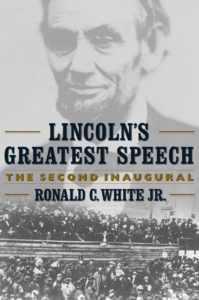
Years ago I read Ronald White’s excellent book about that address, Lincoln’s Greatest Speech. When Lincoln gave it, the brutal American Civil War was nearing it’s conclusion, and Lincoln was preparing the country for the reconstruction to come – a reconstruction he would tragically not preside over due to his death six weeks later.

Since we talk about leadership, innovation and personal effectiveness in this blog, let’s consider some insights from this speech.

It Takes Maturity to Avoid Disputes

Today I ran across this thread from Mark Suster on Twitter.

Many of his points are solid and I encourage you to read the thread in in its entirety, but this one sentence particularly caught my attention: “It takes maturity to avoid disputes”.

It was from a section of his thread that talked about the soul-sucking and cash-draining outcomes of most litigation, and his understanding that it is best to find a way to compromise and move on. In an era of hyper-partisanship and ruthless market competition, the adage that you can “catch more flies with honey than with vinegar” is every bit as apt today as ever.

When he refers to maturity here, I believe he is talking about the ability to subordinate the ego in an emotional dispute. Many business leaders are competitive and have pride in their organization – those qualities helped them get to where they are. But learning how to take a pause and set our egos aside is one of the toughest skills for many leaders.

The battle with the ego is well documented through millennia of philosophical and religious text. Every now and again I flip through Ryan Holiday’s excellent book, Ego is the Enemy for a contemporary view, but St. Augustine and Seneca are among the many great thinkers who have written about our insufferable pride.

Ideas to Overcome Your Availability Bias

How often have we been at our best at moments of adversity rather than prosperity? How much more effective are we at completing a task when we’re busy and have little time, rather than when we have an open schedule and nothing but time? Too much comfort isn’t normal to the human condition.

Our species has evolved by adapting to constant hardship and imminent danger. Our bodies are confused by too much time on the couch in front of a flickering screen. Yet we crave comfort, which can often be our undoing.

We therefore look for ways to artificially challenge ourselves with self-created goals and self-imposed time constraints. We also need to learn about our many blind spots in decision-making.

John McCain, Poetry, and Character

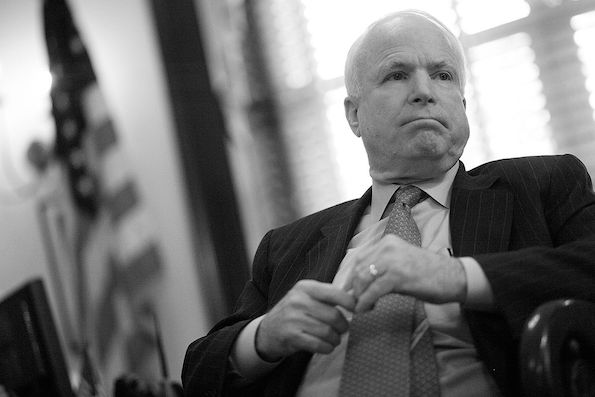
As a nation mourns the passing of a Great American, all sorts of interesting stories about Senator John McCain are being re-told to a national audience thirsting for examples of courage, character and principled leadership. I think my favorite is in this article, where a crew from Comedy Central got on McCain’s campaign bus during his Presidential campaign, set up cameras, and asked him who his favorite poet was.

This is a typical gotcha move in what passes for today’s political theatre. The idea here, of course, is that politicians probably don’t have a favorite poet. It was a great opportunity to make candidate McCain look dumb.  The article goes on to describe McCain’s answer: his favorite poet is Robert Service.

The Comedy Central crew, perhaps thinking they might have their subject over-reaching, asks him to recite his favorite poem from Robert Service. The article then states:

Understanding Business Asynchrony

Due in part to the tyranny of the spreadsheet age, business planning is often too numerical and doesn’t take into account the vagaries of human behavior. How many companies over-hire salespeople because the spreadsheet-based model shows quite clearly that more salespeople leads to more revenue?

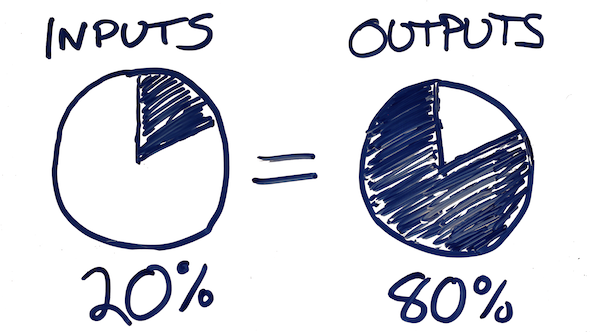
But this is not how organizations work. Many of us have heard of the “80/20” rule – that being that 80 percent of your business will come from 20 percent of your customers. This is an example of the Pareto Principle at work. Pareto wasn’t thinking about sales teams at the time he wrote about it. He was an Italian economist who noted in his era that 80% of the land in Italy was then owned by 20% of the people. The Pareto Principle generically holds that 80 percent of the effects come from 20 percent of the causes.

What Must You Say “No” To?

Michael Porter, the strategy guru from the Harvard Business School, is famously quoted as saying that “the essence of strategy is choosing what not to do”. In the business world, this concept if frequently accepted and infrequently practiced, since while the word “focus” is often used, the word “no” seldom is heard. If you were to see those word clouds hovering over every office building you drove past, you would see the word “focus” prominently featured, as in “we need to focus on the key priorities”, “focus is the key to our success”, “what are the few priorities we’re going to focus on this quarter?” and so forth.

But you’d have a hard time finding the word “no” in that same word cloud.

“No, we can’t take that customer order” is a phrase you seldom hear. “No, you can’t do that project because it doesn’t advance our agreed-upon objectives” is rarely uttered.  And yet, these phrases are the essence of focus. You can’t say “focus” if you don’t say “no”.

Understanding Leverage and Elasticity

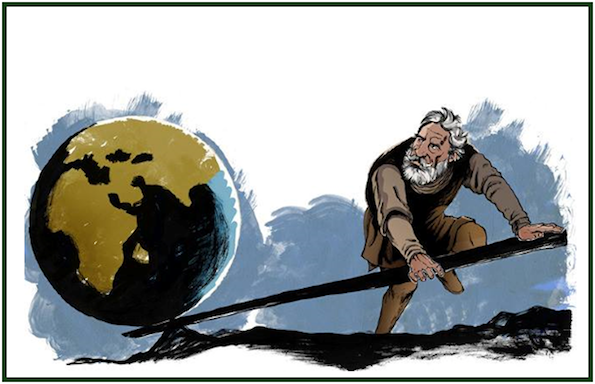
Archimedes famously said “give me a lever long enough and place to stand and I will move the world”.  This astrophysical image demonstrated what has become known as Archimedes Lever – the notion that if you apply the right pressure to the right place, you can gain outsized results, In Archimide’s time, this meant that sailors could move heavy objects using a block and pulley system. In today’s business world, it can mean the difference between making money only when you are working hard versus making money while you sleep.

As is the case with other great changes, I think the path to finding leverage begins with inaction. I’ve always enjoyed the reversed order of a famous aphorism “don’t just stand there – do something!”. Don’t just do something – stand there….and think.

Present Bias and Your Future Self

Among the many cognitive biases that are bugs in our internal software, present bias is one of the more vexing.  Present bias is the tendency, when considering a trade-off between two future events, to disproportionately value the event closer to the present. It is why companies reduce their long-term value in favor of short-term gain, and why humans are bad at saving for retirement.

Hal Herschfield, a marketing professor at UCLA, thought that Americans’ notorious inability to save for retirement – even when there are enough funds to do so – is a result of their “estrangement from their future self”. After all, a 25 or 45 year old doesn’t know the 70 year old version of him or herself. As a result, Herschfield said that “saving is like a choice between spending money today or giving it to a stranger years from now.”.

So Herschfield designed a clever experiment where a group of students were asked to allocate a $1,000 windfall. One group of students, however, were first shown an avatar of their future self at age 70. Not surprisingly, this helped those students “see” their future self as a real person with real needs. These students subsequently allocated considerably more for retirement than the students in the control group.

The Salesperson’s Job Starts When the Customer Says “No”

The “sale” isn’t always the service or product your company provides. It can be the company’s preferred solution to the customer’s problem. It can be getting the customer to follow your company’s preferred payment terms, rather than their preferred terms.

The “customer” might not be a customer of your company. It can be anyone who can impact an outcome important to you. It can be the customer service agent you are talking to on the phone, or a friend or family member who doesn’t understand your point of view.

Overcoming objections seems to be a lost art in today’s tribal political world, but it needs to be front and center in any successful business. Here are some guidelines to overcoming objections…

Seek first to understand, then be understood. Overcoming objections gets easier if the customer believes they have been listened to, and you understand the pressures they are under. This, of course, is Habit 5 from Covey’s 7 Habits book.

Park your ego. Overcoming objections is like dancing together, finding the same beat. You need to be aware of the other person’s body language. It takes time. And while this should be obvious, never tell someone you’re “a great negotiator”, which would only serve to broadcast to others that you operate with a “win/lose” orientation thus putting your customer on the defensive.

Listen “actively”. Re-state your customer’s issues and concerns to confirm understanding.

Everyone is a salesperson at some point. We all seek to impact and shape people’s point of view. This can be an honorable undertaking if the outcome moves toward a worthy objective and people are not viewed transactionally.

Good luck!

Essayer: To Try

I’ve been spending the past few weeks in Paris and consequently have been trying to dust off my knowledge of French. My years in French class have equipped me with just enough understanding of the language to get around town with only minor challenges. If you need help ordering a sandwich “en français”, then I’m your man. But if you want to discuss politics or technology in that same language, you’d find me dull and silent.  But I keep trying, which brings me to the French verb “essayer”, which in English means “to try”.

Montaigne Statue in Paris

Two French essayists that I’ve had an interest in over the past couple years are Blaise Pascal and Michel de Montaigne.  If you’re interested in reading more about Pascal, I recommend Peter Kreeft’s excellent book about Pascal’s Pensées. Earlier this year I was able to get to Montaigne via Sarah Bakewell’s excellent book.

Did you note that in the first sentence of the above paragraph I referred to them both as “essayists”?  In fact, it was Montaigne who linked the French verb to its current use as a way to describe long-form writing. He spent over two decades in the sixteenth century writing his multi-volume book titled, appropriately enough, Essays.  Both men were ahead of their time, in different ways. Presaging today’s social media problem of TMI, Montaigne seemed to write down every thought that passed through his head, including complaints about his penis.

Pascal, writing about seventy years after Montaigne in the seventeenth century, demonstrated that there is nothing new under the sun with this insight concerning the core of the world’s problems (keep in mind that this was written centuries before social media, streaming, and cable news): “All of humanity’s problems stem from man’s inability to sit quietly in a room alone.”

But back to Montaigne for a minute, and the idea of “essayer”.

When it comes to political discourse or compensation negotiations, it is common for one party to insist upon the degree of work and effort they have expended. In politics, one group might claim to be the only group to have an impressive “work ethic”. When it comes to salary or grade complaints, an employee or student might insist that they have given forth maximum effort.

“I tried”, is a familiar protest.  But we are storytellers and our intended audience is ourselves.

I am convinced that stories about our Great Efforts are often narratives that primarily exist in our minds. The fact is, we could try harder and we all know it. There are many ways we evade responsibility for not achieving our potential, and one of the most devious tricks on our bag is to tell ourselves how hard we are trying.  Telling ourselves and others about how hard we are trying is the short and easy path to contentment. Its like laying down in a field of poppies.

Your challenge:

  1. Find one thing in your life that you KNOW is not receiving your best effort
  2. Set forth a realistic objective for making improvements
  3. Tell somebody close to you what your goal is before you start.
  4. Create a tracking mechanism and/or commitment device
  5. Start tracking your effort and communicating results to others.

Essayer doesn’t mean “spend time” on this or that project. It means you bring forth your talent and your sustained focus. It means you give it a real try.

Bonne Chance!

P.S. When visiting the statue of Montaigne (pictured above) across from Paris’s Sorbonne Université , it is customary to rub the toe of his shoe for good luck. So many pre-test-taking students and tourists have done it that his right shoe shines from all the rubbing.  I don’t believe in such things, but why chance it?  I gave it a rub.